Water lines & pressure
Repiping in Springdale & Northwest Arkansas
When the leaks keep coming back, pressure drops, or the water runs rusty, repiping can be the cleanest long-term fix. You get a clear plan on scope, access and timeline before any wall is opened.
Chapter 01
When repiping makes sense
Repiping is not the first answer, and it should not be. The diagnosis comes first, and plenty of problems are a repair. It becomes the smarter move when repairs keep stacking up. If a leak gets fixed in one spot and a different one appears a few months later, the system may be nearing the end of its life, and chasing it one patch at a time costs more in the end than fixing it once.
Pressure is another clue. Corrosion, scaling and deteriorating pipe can restrict flow until showers weaken and fixtures fill slowly, or the pressure comes and goes for no clear reason. Rusty or discolored water points the same direction, since older metal pipe can contribute to color and water quality problems. So can banging, rattling or loud shutoffs, which often mean something needs a more durable fix than a quick adjustment.
Age matters too. Some older piping types are more prone to failure over time, so part of the visit is simply identifying what is in your walls. And if a remodel is coming, repiping while the walls are already open can mean fewer cuts later and a more reliable system afterward.
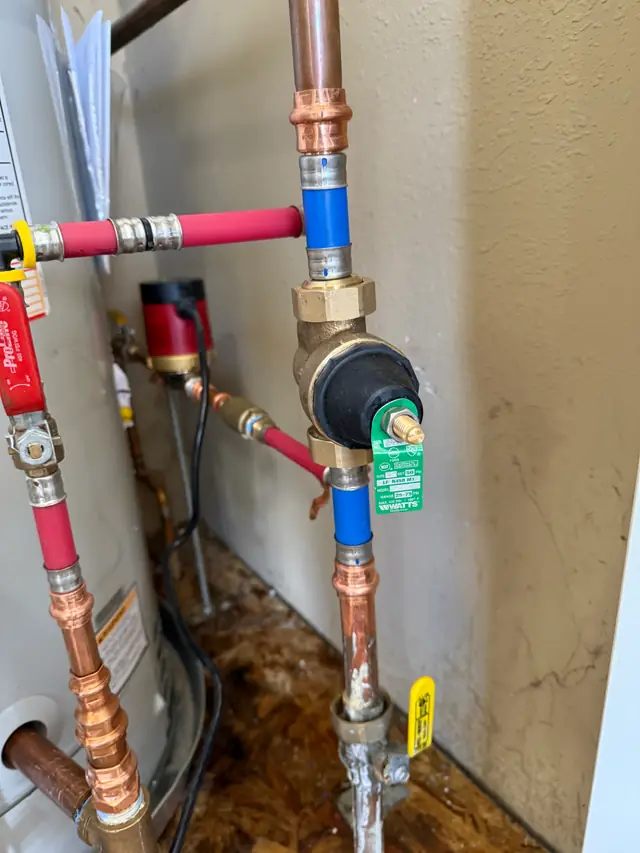
New copper and PEX supply lines with shutoff valves beside a water heater
Whole home, partial, and what gets upgraded with it
Every house is different, so the plan starts with a look at access and priorities, then lands on the cleanest path to a system that lasts. A whole-home repipe replaces the supply piping throughout. It suits frequent leaks and aging systems, and it is the route to more consistent pressure and flow, with planned access and clean patch points.
A partial repipe targets the trouble: a bad section, a high-risk run, or a spot that keeps failing. It is a good fit when the problems are localized, and it can be the budget-friendly choice when it genuinely solves the issue. In that case the highest-risk runs get done first, so the part most likely to cause water damage is handled before anything else.
Pressure control and shutoffs are often part of a clean repipe plan too. That means evaluating the PRV and the main shutoff, isolating fixtures where possible, and finishing with pressure and leak checks. If your pressure is part of the story, the PRV replacement page covers that side in detail.
Chapter 03
What to expect on a repipe
A repipe should run to a plan, not on the fly. You will hear the plan before work starts: what is being replaced, how the crew will reach it, and how long it is expected to take.
The piping gets inspected and the scope confirmed, whole home or partial. Access points and the order of work are planned so your home is protected and the disruption stays reasonable. Then the runs are replaced and the connections secured, with copper and PEX both used across the trade depending on what suits the job.
Before the crew leaves, the system is pressure tested and checked for leaks, patch points are left clean, and you are walked through the shutoffs and the basics of your new plumbing. It is worth knowing where those valves are before you ever need them.
What affects the cost of a repipe
Cost depends on the house, so firm numbers come after the inspection. The size of the home and the number of fixtures set the baseline. Access is the next big factor: a crawlspace is not an attic, a slab is not a multi-story, and each one changes how the work is done.
Scope matters, whole home versus partial areas, along with the condition of the valves and the PRV and any code updates needed. Patch requirements follow from where the access points end up. Whatever the mix, the options are explained clearly before work starts. It helps to bring where the leaks have happened and how often, any pressure or noise problems, whether you are on a slab or a crawlspace, and any remodel plans. Call or text (479) 305-9107 from anywhere in Springdale, Rogers, Fayetteville or Bentonville.
Repiping is the work A Plus Plumbing recommends only after diagnosing first: clear options before work starts, code-first installation, pressure and leak checks, and a clean finish. Call or text (479) 305-9107 to talk through what your house needs.