Water lines & pressure
PRV Replacement in Springdale & Northwest Arkansas
Pressure that runs too high, swings while you shower, or leaves fixtures leaking and pipes banging often traces back to a failing pressure reducing valve. We confirm it, replace it cleanly, and set the pressure correctly.
Chapter 01
How you know the PRV may be failing
Strong flow sounds like a good thing right up until it starts damaging what it feeds. When the pressure reducing valve stops doing its job, the symptoms tend to show up in the weakest parts of the house first. Faucets, toilet fill valves, hoses and supply lines start to leak, often one after another, and the repairs never seem to hold.
Watch for pressure that swings. A shower that changes temperature or force while you stand in it, or flow that jumps up and down with the taps running, suggests the valve cannot hold a steady setting. Banging or rattling in the pipes can be worse when pressure is unregulated, and on a water heater, high pressure can contribute to the relief valve dripping.
A PRV that is simply old or stuck belongs on this list too. If it cannot hold a setting, replacement is often the most reliable fix. If any of this is happening at your place in Springdale, Rogers, Fayetteville or Bentonville, call or text (479) 305-9107.
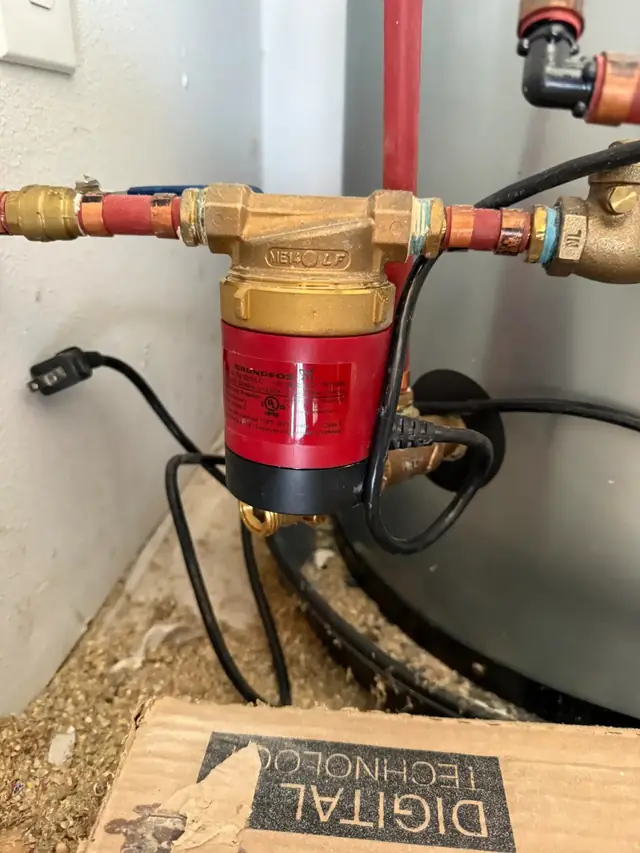
Utility room piping work: a red circulator pump on copper pipe with brass unions
What a PRV does and why it protects the house
The pressure reducing valve brings the city water coming into your home down to a safer, steadier pressure for your plumbing. It is a small part doing a large job quietly, which is exactly why people forget it exists until it fails.
When it fails, pressure can climb too high, and that wears on everything downstream: faucets, toilets, valves, supply lines and appliances. A healthy PRV helps protect those parts, reduces the stress on the water heater, helps prevent leaks caused by excess pressure, and keeps the comfort of the shower consistent.
That is also why a PRV is worth checking when you are chasing leaks that keep returning. Fixing the fixture without fixing the pressure behind it often just resets the clock on the next drip.
Chapter 03
We don't guess. We measure.
We don't guess at pressure. We put a gauge on it, confirm the symptoms you described, and only then decide what the valve needs.
Replacement day stays simple. The current water pressure is measured and your symptoms confirmed, the PRV location and the shutoffs near it are inspected, and the valve is replaced with every connection tested. If the PRV is failing or unstable, it comes out. If it is not the culprit, you hear that too.
The step that matters most comes after the new valve is in: the pressure is set correctly and stability is verified with water running. Then the connections are checked for leaks, the area is cleaned up, and you get the next steps, all explained before and after the work.
What affects the cost of a PRV replacement
A PRV job can be quick or involved depending on the setup, so a firm number comes after a look. Where the valve sits and how easy it is to reach is the first factor. The condition of the shutoff valves and fittings around it is next, since worn ones may need attention at the same time.
Any updates needed to bring connections to code can change the scope, and optional add-ons, such as a pressure gauge or a shutoff upgrade, are your call. If you have a gauge, any readings you have seen are useful to share, along with whether pressure changes during showers, any recent leaks at faucets, toilets or supply lines, and where your main shutoff is. Options are laid out clearly before work starts.
PRV work at A Plus Plumbing means clear options up front, a code-first install with leak checks, and pressure that is set and verified before the crew leaves. Call or text (479) 305-9107.