Low Water Pressure at Home: Causes and Fixes for NWA Homeowners
Pressure problems have different causes depending on where they show up, so start by sorting out how widespread yours is.
October 1, 2026 · 4 min read
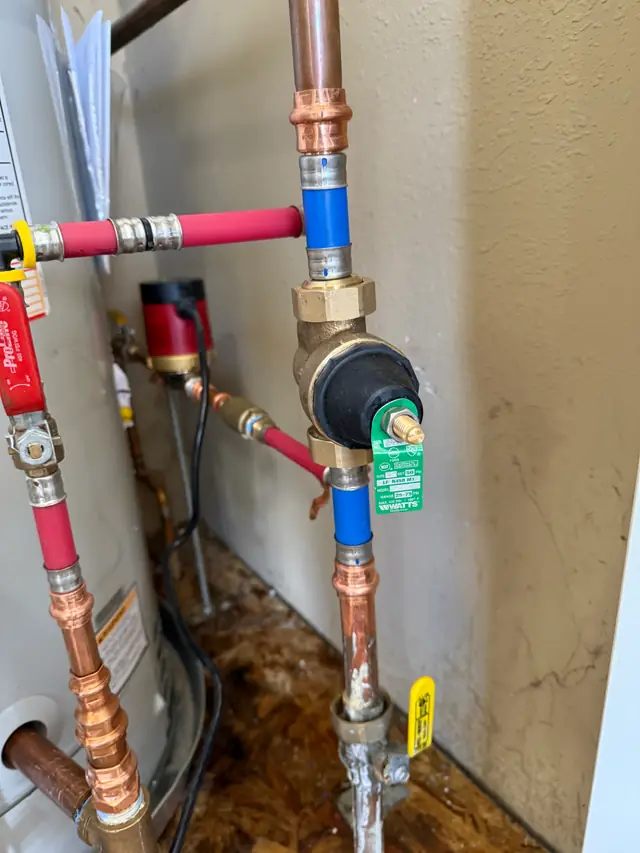
Low water pressure is one of those problems people put up with for far too long. The shower slowly gets weaker, the kitchen faucet takes forever to fill a pot, and eventually you stop noticing. But a pressure problem always has a cause, and the cause can be as small as a clogged screen or as significant as a failing valve or a leak in the line. The fastest way to the answer is to work out how widespread the problem is, then work through the likely suspects in order.
One fixture or the whole house
Before you assume anything is wrong with the main supply, turn on a few faucets in different parts of the house and compare. The pattern tells you where to look:
- One faucet is weak and the others are fine: the problem is almost certainly at that fixture.
- Hot water is weak but cold is strong: look at the water heater and the hot supply.
- Every fixture is weak, hot and cold: the cause is upstream, at a valve or the main line.
- Pressure swings up and down, or pipes bang when a fixture shuts off: suspect the pressure reducing valve.
- Pressure dropped suddenly and the water bill jumped: suspect a leak.
Start with the fixture
If one faucet or showerhead is the weak spot, the fix is often simple. Faucet aerators, the small screens at the tip of the spout, collect mineral scale and debris. Unscrew one, rinse it, soak it in vinegar if it's crusty, and see if the flow comes back. Showerheads clog the same way. If the aerator is clean and the flow is still poor, the cartridge inside the faucet may be worn or blocked, and the shutoff valves under the sink may be partly closed or corroded. A faucet that has failed repeatedly, or whose parts are obsolete, may be better replaced than coaxed along.
The pressure reducing valve
Many homes have a pressure reducing valve, a PRV, where the main line enters the house. Its job is to take the high pressure in the street supply and bring it down to a level your pipes, fixtures and water heater can live with. When it wears out or sticks, you can end up with pressure that's too low, but just as often it goes too high or swings unpredictably.
That's the part many people miss: too much pressure causes trouble as well. It shows up as banging pipes, fixtures that leak or drip soon after they're replaced, a dripping relief valve on the water heater, and appliance supply lines that fail early. It wears on every joint in the house. The reliable way to know is to put a gauge on a hose bib and read the number, and the same approach applies to the fix. As the plumbers at A Plus Plumbing of NWA put it, 'We don't guess. We measure.' If the valve is failing, replace it, set the pressure, and confirm that it holds steady.
Leaks, buildup and aging pipe
When every fixture is weak and the PRV checks out, the next suspect is the supply line itself. A leak in the main line between the meter and the house robs the house of pressure and flow, often with a soggy patch of yard or a higher bill as proof. Our leak detection article walks through the meter test that confirms it.
Older galvanized pipe causes pressure problems another way. Over time, mineral deposits and rust build up inside the pipe wall and narrow the opening, so less water gets through even though nothing is leaking. You may see rusty or discolored water along with the weak flow. Pipe like this doesn't get better with age, and chasing it with spot repairs tends to uncover the next weak spot soon after.
When repiping makes sense
Repiping is a big job, so it should be a decision you reach with good information, not a first reaction. It starts to make sense when you have recurring leaks, low or inconsistent pressure that doesn't trace to anything simpler, rusty water, water hammer, or older pipe material that's reached the end of the road. It can also be timed with a remodel, when walls are already open.
A repipe doesn't have to mean the whole house at once. Depending on the home, the plan may cover the whole system or only the highest-risk runs first, with pressure and valve upgrades included where they're needed. You should get a clear plan before work starts, covering the scope, the access required, and the timeline.
Getting an answer
If you've checked the aerators and the symptoms still point to something bigger, call or text (479) 305-9107 and tell us which fixtures are affected, whether it's hot, cold or both, and whether you've noticed banging pipes or a higher bill. The PRV Replacement page explains how pressure gets measured and set, and the Repiping page covers the options when the pipe itself is the problem.
A Plus Plumbing of NWA, (479) 305-9107
Call (479) 305-9107More articles
Water Heater Repair or Replacement: How to Tell Which You Need
Most water heaters give warning signs before they quit, and some of those signs point to a small repair instead of a new tank.
Hidden Water Leaks: How to Find One Before It Costs You
The leaks you can see are the easy ones, so here's how to catch the ones you can't.