Water Heater Repair or Replacement: How to Tell Which You Need
Most water heaters give warning signs before they quit, and some of those signs point to a small repair instead of a new tank.
October 1, 2026 · 4 min read
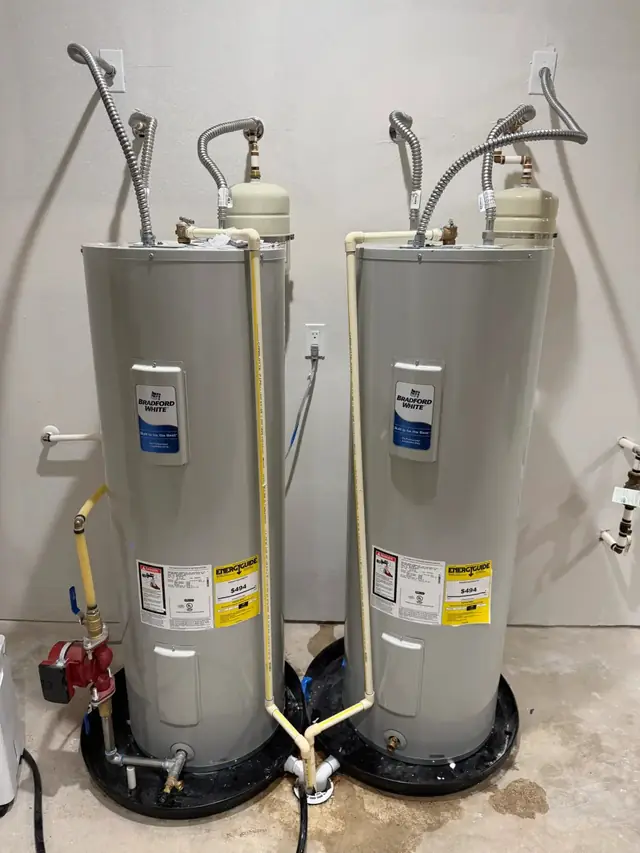
A water heater rarely fails at a convenient moment. It tends to pick the morning your whole family needs a shower, or the first real cold snap of the season. The good news is that most units give you warning well before they stop, and a few of those warnings point to a modest repair rather than a new tank. This guide covers what to look for, what a plumber can realistically fix, and how to tell when replacing the heater is the smarter move for your home in Northwest Arkansas.
Signs your water heater is telling you something
Start with what you can see and hear. A tank that leaks from its base is the clearest signal, because water escaping the steel shell means the shell itself has given up, and no repair closes that. Everything else is more forgiving. Walk through this list before you pick up the phone:
- No hot water at all, or water that never gets as hot as it used to.
- Hot water that runs out much sooner than it did last winter.
- Rusty or discolored water from the hot taps only, while the cold side runs clear.
- Popping, rumbling or crackling from the tank, usually sediment baking on the bottom.
- A puddle or damp spot around the base, or a pipe dripping from the relief valve.
- A gas unit whose pilot light won't stay lit.
Notice that most of these don't automatically mean the heater is finished. Rust in the hot water alone can come from a worn anode rod. A tank that rumbles is often just overdue for a flush. That's why the first job on any visit should be diagnosis, not a sales pitch.
What a repair can usually fix
On an electric heater, the parts that fail most are the heating elements and the thermostats. If you're getting lukewarm water, or the hot supply fades after a few minutes, a failed element is a common cause, and replacing it is a straightforward job on a tank that's otherwise sound.
The temperature and pressure relief valve, usually called the T&P valve, is the safety device that opens if the tank gets too hot or the pressure climbs too high. If it drips all the time, it may be worn out, or it may be reacting to a real pressure problem somewhere else in the house. A good plumber figures out which one before swapping the valve and walking away.
Inside the tank, a sacrificial anode rod does the corroding so the steel doesn't have to. Once the rod is used up, the tank wall starts taking the damage instead. Replacing the rod and flushing out the sediment that settles at the bottom can add real life to a heater that's still in decent shape. On gas units, the gas valve, the thermocouple and the burner parts are the usual suspects when a pilot won't light or won't stay lit. A Plus Plumbing of NWA works on Rheem, A.O. Smith, Bradford White, Navien and Rinnai heaters.
When replacement is the better call
A repair makes sense when the tank holds water and the failed piece is a part. Replacement makes sense when the tank itself is the problem. A leak from the shell is the obvious case. Others include repeated repairs close together, heavy sediment and corrosion inside, a unit well past the service life its manufacturer expects, or a heater that's simply too small for the household you have now. The data plate on the side of the tank carries a serial number that dates the unit, so you can find out its age in a minute with a flashlight.
A fair plumber tells you plainly which side of that line you're on. The straight answer is either repair it now or replace it before it fails, with no upselling and no pressure. The second half of that sentence matters. If the tank is on its way out, putting money into a new element won't buy you much, and an honest recommendation will say so.
Tank or tankless
A standard tank stores a set amount of hot water and keeps it heated around the clock. It's the familiar setup, it comes in gas and electric, and replacing like for like is usually the simplest path. A tankless unit heats water as it flows, so when it's sized correctly you don't run out halfway through a long shower, and it frees up floor space in a garage or utility room.
Tankless isn't a drop-in swap, though. Depending on the house, it can call for a different vent path, a larger gas line, or electrical upgrades, and the unit has to be sized to how much hot water your household actually uses at the same time. Rinnai, Navien, Rheem and Noritz are the names you'll hear most. Tankless units also need periodic flushing so scale doesn't build up inside the heat exchanger, especially in homes with hard water.
The HOT50 offer, and your next step
A Plus Plumbing of NWA lists a $50 Off Water Heater Replacement offer. Mention code HOT50 when you book. It applies to standard water heater replacement, parts and model options vary, and an inspection or diagnosis may be required first.
If your heater is showing any sign from the list above, call or text (479) 305-9107 and describe what you're seeing. The Water Heater Repair page explains what gets checked and fixed, and the Water Heater Replacement page walks through tank and tankless options if the answer turns out to be a new unit.
A Plus Plumbing of NWA, (479) 305-9107
Call (479) 305-9107More articles
Hidden Water Leaks: How to Find One Before It Costs You
The leaks you can see are the easy ones, so here's how to catch the ones you can't.
Frozen Pipes in Arkansas: Prevention and What to Do if One Bursts
A little preparation before a freeze, and a clear plan for the first few minutes, limits most of the damage.